
In this article
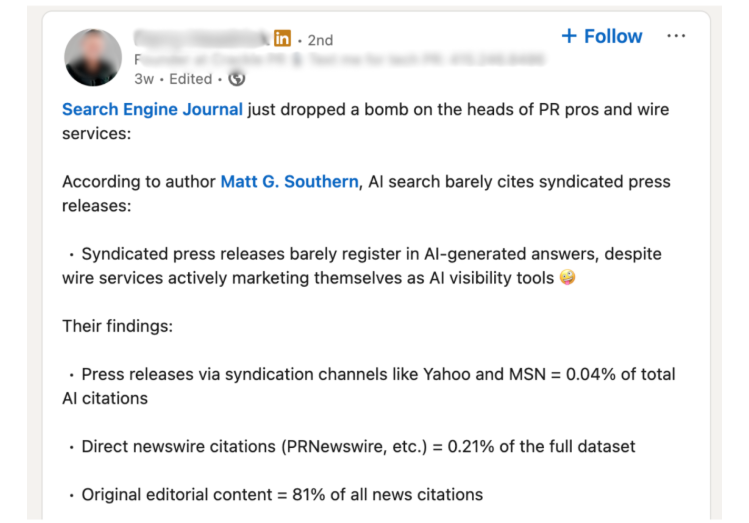
A few weeks ago, I read a LinkedIn post that perfectly illustrated how research can get misconstrued and that making alarming statements without context doesn’t add helpful information to the public discourse. I’ve not shared the actual post because my intent is not to call attention to any one individual. I know that I’ve occasionally felt pressured by the need to post something on my social properties and that pressure led to mistakes or posts that didn’t really add anything edifying to the world. Rather, I want to clarify several of the statements this gentleman made and point out where things all went wrong.
The author of this post wanted to convey that wire services are promoting their ability to support AI search, based on this article in Search Engine Journal. The post is correct about syndicated press releases, but misses the mark about press releases themselves. My experience in querying AI tools and in depth analysis by MuckRack suggests that press releases do support a brand’s potential to show up in AI answers. And, there’s even more to unpack on this topic. First, though, it is important to clarify how syndicated press releases work and why they have limited effect on AI search.
Syndicated press releases are not syndicated news.
When using a wire service, one benefit is having the release published on a reputable third-party site, reviewed by a wire-service editor, and distributed to newsrooms and journalists. In addition, the press release will “syndicate” or feed directly into news sites that have an agreement with that wire service. However, these syndicated releases are not earned media nor are the syndicated news.
Here is how the syndication of press releases works through wire services. Company A writes a press release and uploads it to Business Wire selecting a US distribution. In addition to seeing the release on Business Wire and having metrics about AVE, engagement, and shares, that release syndicates to 150-190 other news sites each of which cites Business Wire as the source. Some stay on these syndicated sites for a few weeks or months. Some disappear within days. These postings do not count as earned media because of their transient nature and because no one made an editorial decision to read the press release, add to it editorially, or verify the content.
There are some agencies or content companies that claim syndicated placements of press releases are earned media, but that is misleading. There might be an incremental lift in branding, and these do create additional touchpoints for a brand, but I’ve not seen clear evidence that they improve performance in AI search. Furthermore, the research published in SEJ suggests otherwise. This shouldn’t be surprising.
Syndicated news is earned media
Syndicated news is quite different. Syndicated news begins as original reporting at a publication that is later republished by other outlets under a syndication agreement. As an example, The Hechinger Report produces original content which is republished by other media outlets. The AP functions similarly. The original story appears first through the AP, and the AP remains credited as the source when it is republished to other outlets.
These syndicated articles add to a brand’s visibility although they don’t seem to heavily influence AI search. The SEJ article reports that “syndicated news content overall, including articles republished through MSN and Yahoo networks, accounted for 6.2% of news citations and 0.9% of the total dataset.” That means that less than 1% of citations were from affiliates, not the original source, which makes sense. LLMs would cite the primary source over an affiliate, but that does not diminish the value of syndicated news articles. A brand does not survive on AI search performance alone anymore than it would survive solely on SEO performance alone.
Original content has greater potential to influence AI-generated answers than reposted content.
One reason that either category of syndicated content — press releases or news articles — may appear less often in AI search is that it did not come from the original source. A likely factor in AI visibility is whether the AI can identify, confirm, and verify the primary source. Anything syndicated is further removed from the primary source.
It might feel like using a newswire then negates the benefit because it is not the authoritative source of news — meaning it is not the company’s website that gets cited. However, newswires might be seen as credible sources because the reputable ones use a vetting process to ensure that news releases come from legitimate company representatives. For example, before my firm can issue a press release for clients, Business Wire first vetted Pando Public Relations as a legitimate public relations firm with an established history of representing companies. Business Wire also confirms our authority to release news for a client by requiring that an executive or senior staff member for that client authorizes us to release news on their behalf.
A cautionary note: Be careful with low-cost wire services that do not have an established history of vetting. I surmise that LLMs can tell reputable wires from the second-generation, low-cost wires, which may be why Business Wire, PR Newswire and GlobeNewswire appear to be cited more often. Muck Rack Generative Pulse data provides evidence to support that conclusion.
Evaluate the GEO potential of a press release in combination with Ground Truth and other assets.
MuckRack Generative Pulse research suggests that press releases are cited in AI-generated answers because they serve as authoritative brand information. They are also dated, which may help AI systems assess recency. Press releases can be structured in ways that are easier for machines to parse, and may contain data they can verify against other reputable sources, such as a company’s website.
Before deciding whether to distribute a press release on the wire, weigh several factors. First, examine how the product class is performing in AI search. If press releases are being cited, then it may be reasonable to assume a well-written, data-rich, and well-formatted press release on the wire will be worthwhile. Secondly, determine if the release content can be repeated and supported across multiple third-party sources and on the brand’s owned properties including a page of Ground Truth, in thought leadership and earned media in respected outlets. If these factors are met, then use the best wire service you can afford, use repeated phrasing and anchors to the brand page, and support it with other forms of verification on third-party sites.
Don’t let AI be your voice or draw your conclusions.
I ran the original LI post referenced above through an AI text detector because I suspected it was written by AI. It seemed like the post was a generalization of the SEJ article, but without the insight a seasoned PR pro might have. It seems my hunch was correct. Pangram’s AI detector said that the post was 100% AI-generated. Perhaps the author used LinkedIn’s AI writer to polish his original post, but the sweeping statements missed a lot of subtlety. After all, there is too much we don’t know about AI search and AI answers.
When using AI, don’t let it draw conclusions for you and when you do use it, confirm everything against the primary source. Misinformation is at an all-time high and careless use of generative AI is adding to the problem. It’s a great tool, but if your own knowledge of the subject is lacking, consider the use of AI as an opportunity to learn so that the gaps get filled in with facts, not speculation.
Links and data referenced in this article:
- Business Wire: Business Wire is Your AI Visibility Engine
- PR Newswire: How Press Releases Make Your Business Discoverable in AI Search
- MuckRack Generative Pulse study, What Is AI Reading
- Fundamentals of Generative Engine Optimization from MuckRack Academy
- Search Engine Journal: AI Search Barely Cites Syndicated News or Press Releases
- BuzzStream: The Role of News Publications in AI Citations [New Data]
This was originally published in PR in EdTech on LinkedIn on April 9, 2026.
Share This Story, Choose Your Platform!
Subscribe to receive tips
There are two ways to subscribe to our PR in EdTech newsletter:
- Subscribe on LinkedIn and see extra content like recent articles on Substacks, and what to do after an article lands in a publication.
- Subscribe via email to receive news earlier and with few more details not shared widely on the LinkedIn newsletter.