
In this article
If you’ve worked with PR agencies before, you might assume retainer agreements are the only pricing structure available. That may be true for established companies focused on maintaining visibility and brand authority. But for companies that are still building their brand, or that need support on smaller campaigns, the typical agency-client agreement may not be the best fit.
There are alternatives to the standard retainer, and each one comes with its own advantages and tradeoffs. Choosing the right one takes more than comparing prices. It means understanding how each model handles scope, billing variability, incentives, and reporting.
Here’s my perspective on some of the most common pricing models, along with considerations that can help you choose the right one and set the engagement up for success. Because clients and agencies experience pricing structures differently, these grades are intentionally framed from the client’s perspective. To help evaluate the tradeoffs, each is graded A, B, or C on five criteria that matter most to clients: predictability, flexibility, incentive alignment, scope control, and reporting clarity.
Fixed Monthly Retainer
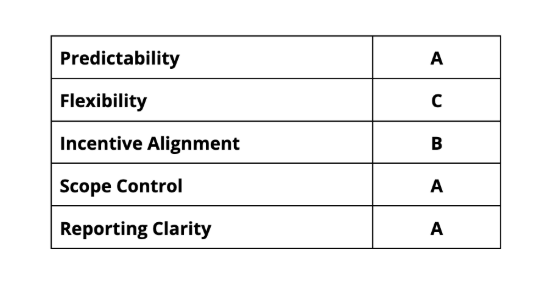
Fixed monthly retainers are typical for large agencies. These agencies need to manage staff capacity across multiple clients while covering the costs of running a large, and sometimes global, agency. Retainers aren’t exclusive to large agencies, though. Smaller agencies may prefer fixed retainers for some of the same reasons.
From the client side, fixed retainers usually offer the clearest scope boundaries because the monthly fee and deliverables are defined in advance. Walk into any retainer discussion expecting a clearly defined scope of work and a list of monthly deliverables. Deliverables are not the same as predictions about story placements. Earned media cannot be predicted with certainty, so if an agency makes predictions, ask for clarity on what makes up the list of landed stories. For example, a placement count might include articles through paid engagements (either for influencers or paid contributor spots at industry trades). Placements might also include the pickup from press releases. It isn’t necessarily wrong to count these as placements, but it can be misleading to lump them together with earned placements without making the distinction clear. Ask for a breakdown of what constitutes placements to avoid confusion later.
From the agency side, fixed retainers are notoriously difficult because of “scope creep”. That’s when new projects or significant wrinkles arise throughout the engagement that are not specified in the scope of work and that are going to take time and potentially pull away from the originally scoped priorities. As the client, look carefully at the deliverables to make sure they are sufficient for the fee. Best practices on the agency side mean that we plan for some contingencies, but we know the point when it gets out of hand. There is also the matter of precedence. Accommodating one new out-of-scope request without pushback often creates a precedent for more of the same.
To hedge against scope creep, make sure it is clear what the scope covers and know how out-of-scope will be raised to the client and billed. Every productive agency-client relationship will wander into new territory and spawn new ideas. To facilitate that kind of growth, you want to make sure new ideas can be accommodated either by shuffling the existing list of deliverables or by billing adjustments that won’t surprise you later.
What to ask for in a fixed retainer:
- List of monthly deliverables
- Description of what is considered out-of-scope and the fees — either by project or by the hour — to accommodate that work
- Clear description of who will be on the client team, what level they are, and how accessible they will be
- Cadence and duration of planning meetings
- Metrics of success that both parties understand and agree upon with benchmarks set in the early weeks of the engagement
Hourly
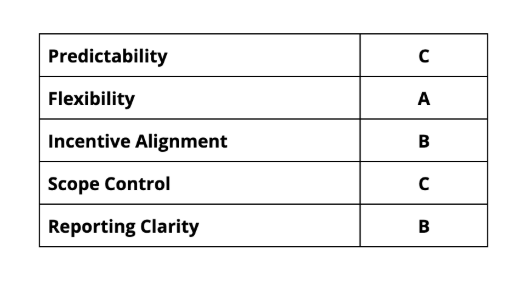
Hourly work is more common for smaller projects or clearly defined campaigns. Such agreements can be helpful for startups or companies needing to launch a product. Lots of agencies, especially small firms and boutique agencies, like to have some hourly work on hand. In our case, we like to have a few hourly clients on hand, especially those that seem very promising for the future, or are in a space new to our team.
A good way to set up an hourly contract is for the client to enter negotiations with a budget range in mind. This way, while explaining your intended outcomes, the agency should be able to give a preliminary scope, and then estimate hours and cost. If what the agency presents matches your budget, the negotiations can proceed. If it doesn’t, state the limit and ask if the agency can adjust the proposal.
In my experience, knowing a company’s budget is very helpful for both parties. With our long experience in EdTech PR, we can help a company narrow down its wishlist to the tactics that will have the most profound impact. Explaining your budget is not pulling a negotiation chip off the table. In my experience it is the quickest and most effective path to finding an agency that can achieve what you need at the budget you can afford.
What to ask for in a hourly agreement:
- Clear description of where your account falls in the PR agency’s hierarchy
- How much access you’ll have to the agency team
- A preliminary plan for reaching the objective
- Optional items and their potential costs
- Options for extending or rewriting the agreement
Fee for Performance (Fee for Placement)
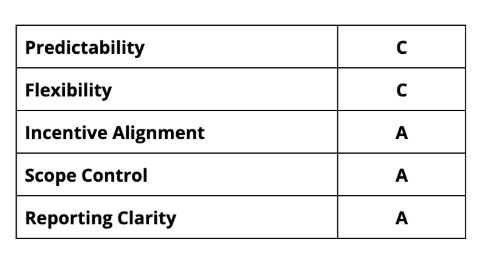
Sometimes media and PR agencies offer fee-for-performance contracts. These can be highly productive, but they require the tightest scope of any model in this list. Fee-for-performance agreements also benefit from being crystal clear about the outcomes right down to the number, type, and publication tier (or value).
When these agreements are structured well, reporting can be exceptionally clear because payment depends on tightly defined outcomes. Be sure that you clearly understand the metrics of success, such as incremental gains in share of voice, or placement counts. Look closely at the underlying description or categorization of the placement itself (placement, feature, byline, award, etc.) and the tier or ranking system for the outlets. That ranking system can be an industry standard such as Tier 1, national, regional, or local media, or it can be a ranking system designed by the agency and approved by the client.
This clarity is necessary because without it, you might be misled into thinking you’ll have 150 placements when in fact, the agency considers the 150 press release pickups to be placements. Share of voice can be a better measure, but it can also be skewed by low-value noise. Have these discussions early so that the agency can focus on the goal, and the client knows what to expect.
What to ask for in a Fee-for-Performance agreement:
- Measurement metrics, including a definition of items being counted
- Contract duration and options for renewal
- A clear definition of what the client is expected to provide to support pitching and writing.
Minimum Retainer with Hourly Billing
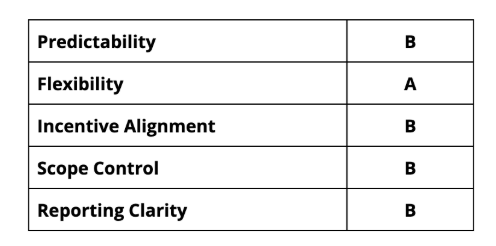
A minimum retainer with hourly billing is a compromise billing structure that has advantages on both sides. Clients have the flexibility to add projects and build on projects that have gone particularly well. Agencies can expect a certain baseline revenue with which to plan staffing needs. The tradeoff is that the client faces a bit more uncertainty about each monthly bill and the agency has to deal with fluctuating monthly revenue.
When Pando engages in a contract like this, we ask clients to set a quarterly cap, an amount the full quarter’s invoices cannot exceed so that we can better manage our staff and contractors. If your industry is cyclical, as education often is, the quarterly cap makes it easier to plan the heavy and light months while keeping within the budget.
Ask the agency to provide the same clarity needed for fixed monthly retainers, and pay special attention to what is in scope, what is out of scope, and how overages will be billed. Know the hourly rates and the terms for rate increases or staffing changes. Set the metrics of success early and have your benchmarks set within the first few weeks.
What to ask for with a minimum retainer billed hourly:
- List of monthly deliverables
- Description of what is considered out-of-scope and the fees — either by project or by the hour — to accommodate that work
- Staff levels and rates aligned to the members of the team
- Whether meetings are considered billable time or overhead
- A monthly or quarterly cap written into the agreement
- Metrics of success that both parties understand and agree upon with the benchmarks set in the early weeks of the engagement
No single pricing structure is the best one. The best one for your brand suits your budget, your tolerance for billing variability, the complexity of the work, and fit with the agency. Evaluating how clearly the agency can define scope, deliverables, and success metrics from the start is equally important as evaluating their ability to deliver.
A fixed retainer may be the best fit when you want predictability in budget, scope, and deliverables. Hourly billing might make sense when flexibility matters most. Fee-for-performance arrangements can work well when outcomes are narrowly defined and both sides agree on metrics of success. And a minimum retainer with hourly billing can offer a useful middle ground when your needs are likely to shift throughout the engagement.
Whatever structure you choose, getting the most value and results from the relationship depends on clarity. The more explicit the agreement is about scope, billing, deliverables, and reporting, the more likely it is to produce a productive long-term partnership.
This was originally published in PR in EdTech on LinkedIn on April 23, 2026.
Share This Story, Choose Your Platform!
Subscribe to receive tips
There are two ways to subscribe to our PR in EdTech newsletter:
- Subscribe on LinkedIn and see extra content like recent articles on Substacks, and what to do after an article lands in a publication.
- Subscribe via email to receive news earlier and with few more details not shared widely on the LinkedIn newsletter.